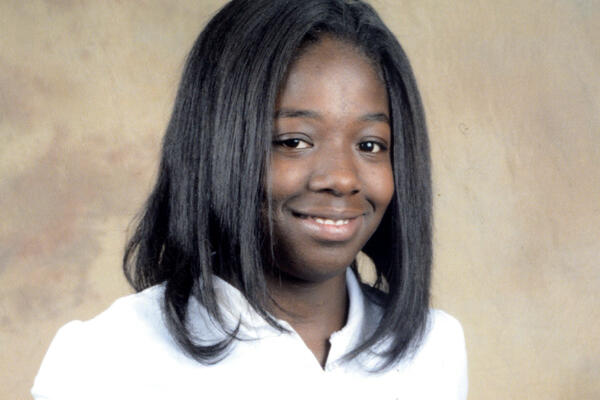
Among the sea of white shirts milling around the Germantown Mennonite Church on Washington Lane, Anna Guarneri stood outside in the courtyard talking to and playing with the children who were too young to sit and listen to New Covenant Church of Philadelphia's gospel choir. Despite the gloom and rain on June 3, about 1,000 white-clad Philadelphians came to the Northwest to participate in the annual Interfaith Walk for Peace and Reconciliation.
The walkers included people from different races, backgrounds and religions. Guarneri took a break from playing with the children to look around, and with the sounds of the gospel choir providing an ideal backdrop, she observed a Muslim and Christian talking, and others standing with eyes closed, listening and reflecting. Guarneri smiled. These people were going to remember this day for a while, and those watching from the sidewalk had to be affected by this diverse and harmonious group. And that's exactly what she wanted.
The interfaith peace walk is just one of the events Guarneri, a small, sweet 23-year-old from California, helped organize in the past year to promote peace by making statements that she hopes will inspire people. Her passion in this mission represents the hopeful energy of a more aware, potentially reforming city. But despite her similarity to Philly's growing reform mind-set, Guarneri isn't native to Philadelphia. And without Philly Fellows, a program started last year offering yearlong fellowships to 15 graduates of local colleges, it's unlikely she'd be here now.
Five years ago, Guarneri moved from Oakland, Calif., to attend the University of Pennsylvania.
"I sought a school on the East Coast because I wanted to challenge myself with a completely new environment, and figure out if I could function outside the liberal Bay Area," Guarneri says. "People at home knew I wanted to go to Penn because it's a good school, but not why I'd want to stay in Philly afterward."
Last May, Guarneri graduated with a degree in cultural history. Though she was interested in staying in Philly, the prospect of getting a job, housing and forming a life in a city so far from family was daunting.
Until Philly Fellows.
Tim Ifill and Matt Joyce conceptualized Philly Fellows three years ago with the intention of helping Philly — a city known for losing some of its well-trained students to other cities — retain some of its local university graduates.
But Ifill and Joyce weren't looking for the typically hard-to-retain research and medical leaders. Instead, they sought socially aware students who could facilitate projects for the city's nonprofits, and potentially become future leaders of those organizations.
"We hope that tomorrow's civic and nonprofit leaders [will have] once [been] Philly Fellows," explains Joyce, sitting at the outdoor cafe of the Other Green Line in West Philly, down the street from the row home he and Ifill — roommates since college — share with three other guys.
The program is modeled after the Haverford House program at Haverford College, Ifill and Joyce's alma mater. By offering yearlong housing, a stipend and stimulating jobs with local nonprofits such as Community Legal Services and Philadelphia Green, "We give [graduates] the chance to give Philly a shot, give Philly a year," Joyce says.
Guarneri spent her year at the Neighborhood Interfaith Movement, an organization that connects congregations from all religions to advocate for peace and human rights. Faith-based communities already work toward similar goals, but together their influence can be greater, says Guarneri.
As NIM's council coordinator, a position that lay dormant for years and was resurrected by NIM for the fellowship, Guarneri's brought kids into the Stenton Family Manor, a family shelter in West Oak Lane, and did art projects with mothers and their children. She also organized a daylong youth arts summit that inspired kids to resolve conflicts through peaceful communication instead of violence.
An eight-week conflict resolution program involving theater, which started in June, will likely recur during the school year at Build a Bridge in Germantown, Guarneri says, to keep children busy and off the streets.
"When people read the stories about these murders, people aren't thinking about the hopelessness of the youth that is leading them to buy guns, lean on drugs," says Guarneri. "These kids don't realize they have other options."
"The issue of violence requires that all of us commit to doing our part to change the current reality," Guarneri continues. "Because we are working to change mentalities, symbolic acts and tangible programs are important to the movement."
The idea behind Philly Fellows is that the work would "ripple out," says Ifill. The widest "ripple effect" to come from Guarneri's work is a 67-page peace resource guide for congregation leaders.
"It's crazy that [a guide] hasn't been made before," Guarneri says, sitting in InFusion Coffee and Tea in Mount Airy, down the street from NIM's offices. "If people are looking to churches and faith-based organizations to promote peace, then giving them the tools to be able to do that is really important."
The guide, which was initially created for faith communities in the Northwest, provides sample reflections, prayers and sermons from a wealth of religious traditions that spiritual leaders can use to encourage congregants to get personally involved in the peace movement. It also contains mock petitions, fact sheets on the challenges students and Philly youth face, and volunteer opportunities for mentoring, tutoring and more in the city's schools and nonprofits.
Since nothing like this has been done in any part of the city, the Mayor's Office of Faith-Based Initiatives asked and received permission to print and distribute copies of the guide to congregations across the city.
And the guide won't be Guarneri's parting gift to the city. At the end of the month, when her fellowship concludes, Guarneri will be officially hired by NIM.
"We're very pleased with her, and we crafted a fellowship for her that has really moved us ahead in our efforts to serve our congregations and community," says Rabbi George Stern, NIM's executive director.
Guarneri admits that without such a positive experience with NIM and Philly Fellows, she would have been unlikely to stay in the Philly area.
"Anna is our best-case scenario," says Ifill. "She's someone who would not have come here and stayed here without the program."
But Guarneri isn't alone. She's one of 10 of the original 15 Fellows who have decided to stay in Philadelphia.
Of five who aren't sticking around, four decided to leave the city for other opportunities, and one remains unsure of a next step.
One of those leaving, Allison Balter, a Swarthmore College graduate originally from Connecticut, turned down an offer from her Fellows nonprofit, Education Law Center, for a job with the Portland, Ore., child advocacy organization Stand for Children.
She says without her experience as a Philly Fellow, it is unlikely she would have been offered the Stand for Children position.
"The Fellows position built on interests I already had, but it showed me how to develop a career out of those interests," she says.
Ifill and Joyce say they are pleased with the way the first class of Philly Fellows worked out.
"[The first 15 fellows] dove into the city and the program and really set the bar high for the next couple of years," says Ifill.
The future promises to be interesting for the Philly Fellows program, which became its own nonprofit 501(c)(3) entity in May. It had been operating under the Greater Philadelphia Urban Affairs Coalition. Ifill and Joyce plan to gradually expand Philly Fellows by adding to the number of students, nonprofits and colleges involved.
On July 30, a new class of 15 Philadelphia graduates will start positions at their assigned nonprofits, and on Aug. 1 will be officially welcomed to Philadelphia with a reception in City Hall and a meet-and-greet with Mayor John Street.
The program hasn't expanded in number yet, but the group of 15 includes graduates from two additional schools, reaching seven in all — St. Joseph's University, University of Pennsylvania, Bryn Mawr College, La Salle University, Temple University, Swarthmore College and Haverford College.
Stephen Danley, a Penn graduate originally from Germantown, Md., will be the second generation of Philly Fellows at NIM.
Whether he'll decide to remain in Philadelphia for the long term is yet to be decided. But the city has a year to convince him that this is the place to be, and Guarneri as an example.
Senior writer Doron Taussig wrote about the inaugural Philly Fellows program in June 2006. Read it at www.citypaper.net.
Comments
Be the first to comment on this article.